Mongolia is located in Central Asia, bordering Russia and China. Today, Mongolia is one of the top 10 countries to visit. And the following information so that you can get the best information about the 10 most beautiful places in Mongolia.
Great Land Stone of Dundgovi Province:
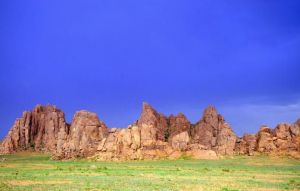
Great Land Stone Mountain located in the Gobi-Ugtaal and Bayanjargalan soums of the Dundgovi province. This is the largest granite region in Mongolia.
Ikh Gazar Chuluun Uul, located in the Gobi-Ugtaal and Bayanjargalan soums of Dundgovi province, is the largest part of the Greater Mongolian Granite Region. It is one of the most beautiful places with its sharp peaks and remains of cliffs. It was taken under special state protection by Parliament Resolution No. 30 in 2003 to protect its natural beauty and geographical features. It is located 80 kilometers southeast of Mandalgobi.
The Great Land Rock consists of two parts that extend for about 20 kilometers from north to south, the highest point being Mount Erlog, 1706 meters high. The granite cliffs of the continent are composed of bright pink coarse-grained crystals with various longitudinal, vertical and transverse fissures. It is located 80 kilometers southeast of Mandalgobi. There are more than 40 caves in the Ikh Gazar stone area, including Toonot, Aguit, Ekhiin Umai, and Rashaant, which are located on a separate granite cliff in the eastern part of the Ulziit and Sumber Mountains. The cave is located on the southwest side of the granite cliff.
Ulaan Tsutgalan waterfall in Uvurkhangai Province:
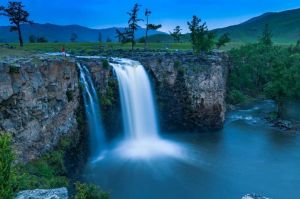
The Bat-Ulzii soum of Uvurkhangai province has the largest waterfall in Mongolia, Ulaan Tsutgalan. The waterfall is about 5 meters wide and descends from a height of more than 20 meters, about 30 kilometers west of the center of the soum. Some people call it “Orkhon waterfall”. But this is a misnomer. This is because the Khangai Mountains, such as the Khyatruun and Ulaan rivers, which originate from the Khyatruun and Ulaan rivers, formed the waterfall when they flowed into the Orkhon River. The Orkhon River flows through the gorge, which is about 20 meters high, about 50 kilometers from Undur Oyster to the Ongotsot gorge.
The waterfall was created when the Red River descended into this gorge. As the river receded, it eroded the bedrock and receded about 100 meters from the Orkhon River, creating a depression about 10 meters deep. Besides Ulaan Tsutgalan, there are four or five large and small waterfalls in the Bat-Ulzii soum of Uvurkhangai province, such as the “Orkhon waterfall or small tributary”, the “Tatuurin waterfall” and the “Tsagaan gol waterfall”.
Uran Togoo Uul of Bulgan Province:
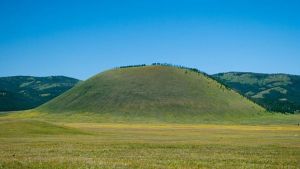
In the Khutag-Undur soum territory of Bulgan province, about 80 kilometers northwest of the city of Bulgan, on the west side of the main road to Khuvsgul. There are four extinct volcanoes named Uran, Tulga, Togoo, and Jalavch. Mountains that erupted during the Quaternary, last extinct 20-25 thousand years ago.
Uran Togoo is 1686 meters above sea level, the mouth of the house is intact, 500 to 600 meters wide and 50 to 60 meters deep. It is currently a circular lake about 20 meters in diameter and 1.5 meters deep, surrounded by forests. The Tulga Mountain crater eroded to the northeast, south, and northwest, leaving three round heads like walls as three cornerstones.
Togoo Mountain is 1540 meters above sea level, Tulga is 1620 meters above sea level and Jalavch Mountain is 1560 meters to the west. The mouth of the Togoo Uul house is intact, it is about 400 meters wide, 100 meters deep, and is shaped like a really big sheep pan. These mountains were protected by the state in 1965 and covered as a natural monument covering 5,800 hectares.
In addition to larch forests, poplar, cottonwood and birch trees grow. There are deer, argali, roe deer, pigs, ibex, marmots, squirrels, brown rabbits, and moss-covered brown rats. There are squirrels, sparrows, owls, hawks, partridges and winters, and the cocoons come to Lake Uran for the summer. Reptiles are common in this region. In the cold season, these animals live in shame in the heat of the deep steam and volcanic gas. There are many tombs and burial mounds near Ikh Togoo Mountain.
Khuisiin Naiman Lake, Uvurkhangai Province;
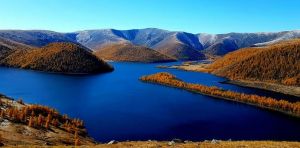
Mongolian Monument: There are eight beautiful lakes located 45 km northwest of Uyanga soum, Uvurkhangai province, in the middle of the beautiful Khangai mountains, in the middle of a volcanic eruption.
Khar Nuur of Zavkhan Province:
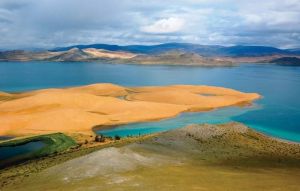
Ulaagchnii Khar Nuur, located in the Erdenekhairkhan soum of Zavkhan province, is one of the most beautiful places with a unique formation surrounded by sand like the sea.
Khamrin Monastery, Dundgovi Province:
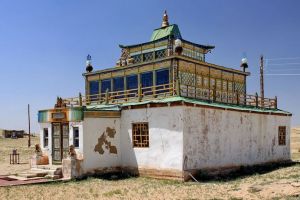
It is located 45 km south of Sainshand, the capital of Dornogovi province. D. Danzanravjaa, an illustrious and famous Mongolian nobleman of the 19th century, founded the Khamrin Monastery in 1820 at the age of 17 in Uvur Khamar. The monastery was built in 1821, the first year of the Manchu dynasty. The monastery had four sections: Zuun Khuree, Baruun Khuree, Tsokhon, and Kalachakra, mostly with Tibetan and Mongol temples. Noyon Khutagt lived mainly in the eastern part of the country, and in addition to the Lavran temple, Agva datsan, children’s datsan, school and library, there were Khamba, Lama, Shuteen and Nomchi aimags. There was a funerary temple of Oidovjamts IV and Luvsandondov VI, and Danzanravjaa and his successors lived in the temple of Lavran. It was a two-story building in the shape of a Tibetan temple with a double-walled door.
Terkhiin Tsagaan Lake, Arkhangai province:
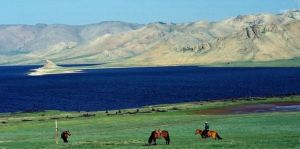
Freshwater lake located in Tariat soum of Arkhangai province and close to Khorgyn Togoon, one of the nine wonders of the province. The North and South Terkhiin rivers, which originate from the Khangai Mountains, are blocked by the melting of the Khorgo volcano. On a small island in the middle of the lake, the birds build their nests and lay their eggs. Rare birds also live. Nuur Tolgoi is part of the Khorgiin Strictly Protected Area.
Baga turgen khurkhree (waterfall)
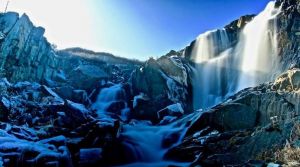
One of the most beautiful places in Altai Tavanbogd National Park is the Baga Turgen waterfalls in the Baga Turgen gorge, the valleys of the Khoton and Khurgan lakes, Tsengel soum. The waterfall originates from the snow capped mountains and is found in nature, creating a beautiful natural wonder. The height of the waterfall is 15 meters, which is considered the highest in the province. The surrounding mountains are covered with Siberian fir and larch trees, while the Baga Turgen river gorge is rich in willows and shrubs. In spring and summer, the Mongolian grayling, a native fish to the area, spawns in the steep mountain rivers.
Erdene Zuu Monastery
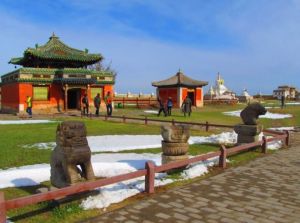
Erdene Zuu Monastery is the oldest Buddhist monastery in Mongolia. The monastery is located near the center of the Kharkhorin soum, Uvurkhangai aimag, near the ruins of the ancient city of Kharkhorum. This monastery is a World Heritage Site of the Orkhon Valley.
In 1580, Abatai Khan and his younger brother Tumen Khen met with the Third Dalai Lama and promised to build a monastery in their area. The temple is written in a manuscript called Biography of the Supreme Enlightenment. The Kharkhorum ruins were used to build the monastery.
Later, in 1586-1674, he built three hundred churches and Rigsum Gomba churches. Luvsan-Odser, the third monk of Erdenezuu, erected a stupa at the four corners of the ruins of the ancient Takhai wall, which became the base of the current wall fence. The monastery was destroyed in the war in the 1680s and was rebuilt in the early 18th century. Between 1701 and 1705, the Ochirdari temples, the Avid temple, and the Central Stupa were built. Between 1771 and 1792, Dagvadarjaa, the seventh monk, built Tsogchin Ikh Dugan and the current Lamiran temple complex.
In 1796, Lama Dagvadarjaa supervised the reform of the Erdenezuu monastery and negotiated a price with the Chinese company Yun-da-a to renovate the monastery buildings. During the renovation, the church buildings, built before 1796, were repaired and 50 stupas were erected as the basis for the ruins of the ancient Takhai village. Between 1802 and 1813, 56 more stupas and walls were built between the stupas built by philanthropists, nobles, bailiffs, monks, and individuals. After that, a Dashchoilin province temple was built in 1803, a Darjaa gomun province temple and Janchivlin province in 1826. By 1872, 62 churches in the interior had been completely rebuilt.
Mongolian settlements, as well as witnessing strict procedures like where to build a building, similar to the general layout of furniture in a Mongolian ger, and where to ask for land to build a building. Erdene-Zuu was left only as a museum, and the only monastery in Mongolia was the Gandan Tegchenling Monastery in the capital, Ulaanbaatar. However, after the collapse of communism in Mongolia in 1990, the monastery was returned to its monks and Erdene Zuu was once again a place of worship. In 2004, a new Buddhist school was established in the monastery. Today, Erdene Zuu is a Buddhist monastery and museum open to tourists. On a hill outside the monastery there is a stone in the shape of a man’s penis. The stone is said to suppress the monks’ sexual desires and help them maintain the priesthood (Myagmarsuren.D).
Gobi Desert
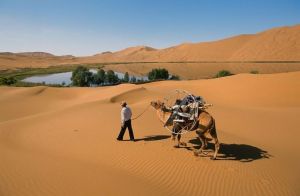
The great desert region of East Asia. The Gobi stretches across large portions of both Mongolia and China. It is a rain-shadow desert, formed by the Tibetan plateau. The Gobi Desert is not only famous for the discovery of dinosaur species, but also for its rich natural resources. The Gobi Desert is rich in deposits of copper, gold, and coal. One of them is called Oyu Tolgoi, which is the third largest copper and gold mine in the world.