Ancient Egypt is one of the most fascinating cultures that has ever inhabited the earth, and despite all the research and studies conducted over the past decades, there is still much mystery surrounding its lifestyle, traditions, and beliefs.
One of the main characteristics in which all the investigations coincide is that the Egyptians had a fascination for animals and many of them were used to explain incomprehensible phenomena or were associated with gods. It is not illogical if we think about what life was like at the time and all the dangers that humans constantly faced. Usually the animals with the strongest religious and spiritual significance were the closest to them, the simplest they could see on a daily basis. In this case, Egyptians develop a special devotion to cats above any other animal. The reason why is still uncertain and remains one of the many mysteries about Ancient Egypt.
What we know for sure is that the Egyptians had great admiration for cats, as they were one of the most revered species. The Egyptians were the first civilization to domesticate them and they were treated as one more member of the house. Despite being used as a protector of homes, some studies suggest that the Egyptians believed that cats were related to divinities. That is why they received privileged treatment from the community.
Before reading, keep in mind that this is a general compilation of interesting facts, some of them may change slightly depending on the era we are referring to. However, all these statements were true at some point in its ancient history.
This is a list of 10 curiosities about cats in ancient Egypt that you may not know …
1. The goddess Bastet was represented with the head of a cat.
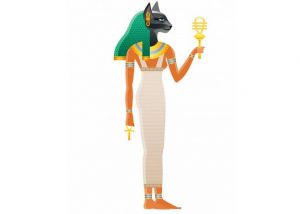
The goddess Bastet was generally depicted with the head of a feline and a golden ear. It was believed that one of the ways people could offend the goddess was to harm one of her cats. When she was really angry, she could transform into a bloodthirsty fearful lion and the only way to calm her was by offering her beer. She represented beauty, joy, love, happiness and she was the protector of humans.
Bastet was extremely popular during the second dynasty (2890-2670 BC) and had its cult center in the city of Bubastis. It is believed that a temple was built in the city in her honor and a mummified cat was buried inside as an offering to the goddess.
2. The Egyptian word for cat was an onomatopoeia that sounded like an actual cat.

According to experts, the word cat in ancient Egypt was pronounced as “miu” or “meow”. This refers to the sound cats make when they meow.
It is particularly curious that despite their great admiration, they only had this word to refer to cats. It was a general word, which means that they did not differentiate between species or any other categorization. Also, in the Egyptian alphabet there is a hieroglyph to exclusively represent cats, which is obviously the silhouette of a cat.
3. Killing a cat or being involved in the death of one was punished by death.

Killing a cat was considered an important capital, so the punishment was that the victim suffered the same result as the victim, death. Depending on the period of time, if the death occurred by accident, the penalty was the same or could be replaced by the payment of a fine. As Herodotus relates, Egyptians trapped in a burning building would save the cast first, before attempting to save themselves, someone else, or attempting to put out the fire. Some experts suggest that even the emperor could not forgive someone who had committed this crime. There is a popular story among fans that even the Pharaoh Ptolemy XII Auletes, father of the legendary Cleopatra, could not stop the death of a Roman soldier who had accidentally killed a cat. Then the poor soldier, unaware of the gravity of the crime that he had committed, was sentenced to death.
However, some theories suggest that at certain times cats were sacrificed and mummified in the city of Bubastis as an offering to the goddess Bastet, of whom we have spoken in the first curiosity. Other theories also suggest that cats could be euthanized to be buried next to their owner so that the cat could accompany him on his journey to the other side. These speculations are interesting because it means that depending on the period there could be exceptions to this law.
4. The death of the family cat was a tragedy.

The cat was considered as one more member of the family, that is why they receive the same care as the rest of its members, especially after death. The richest families mummified their cats with jewels, once they passed away. Some owners even buried themselves with their cat. When the family cat died, the entire family participated in the grief that involved shaving their eyebrows as a symbol of pain and sadness. However, not all cats received treatment. Like today, only those who come from a wealthy family would enjoy such treatment.
5. They had cat cemeteries
The ancient Egyptians had a wide range of pets, including cats, dogs, hippos, falcons among many others. As we have mentioned, domestic pets were mummified and generally buried with their owners. But the animals were also mummified on a large scale. This gigantic cemetery was located in Berenike, a port city on the Red Coast and is estimated to be almost 2,000 years old. It belongs to the predynastic era, when the Roman Empire controlled the region. 100 complete animal skeletons were found, including 86 cats, 9 dogs, and 2 monkeys. Although this was not the first discovery of mummified ancient pets, it nonetheless emphasizes the great efforts that the Egyptians and Romans made to care for these creatures.
6. It was forbidden to smuggle cats out of the country
The export of cats out of the country was strictly prohibited by law. There was a specific branch of government whose task it was to tackle this problem. Government agents were sent to other lands to find the smuggled cats and returned them. However, Phoenician and Greek traders and later the Roma legions illegally exported cats to Europe.
7. The Egyptian cats weren’t like our cats.
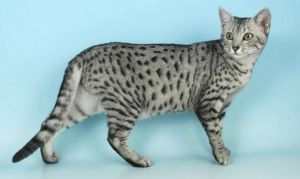
Like any other domesticated species, wild cats had a different constitution that evolved and changed when they began living with humans. As we mentioned earlier, the Egyptians only had one word for cats because they did not differentiate between the different species. Nonetheless, researchers have been able to identify three different types of cats from mummies found in various locations. The first species is called Felis lybica, commonly known as the African wildcat. This was the most common breed and experts are completely sure that it was domesticated.
The second breed that can be found was the Felis chaus also known as the jungle cat. Although it is likely that this was also domesticated, there is not enough evidence. Finally, we can find the Felis serval or serval. This was not a common breed and was probably not indigenous, but they were imported from Nubia in southern Egypt. Today this region belongs to the country of Sudan.
8. Cats were commonly used as guardians and as hunters
Cats were a symbol of protection. It is a well known fact that they are extraordinary hunters. The Egyptians used to keep them in their homes where cats stalked rats, maces, scorpions, and snakes. It is believed that this is how they were domesticated. In exchange for keeping undesirable little animals out of the house and protecting family members (as the goddess Bastet did), cats were offered food, a home, and a safe place from predators.
Furthermore, other studies also suggest that cats were used to chase baby birds. The owner or in this case the pursuer threw a wooden tool, which looked like a boomerang, to kill the bird. The cat was in charge of collecting the prayer and returning it to the owner.
9. The Egyptians lost the Battle of Pelusium because of its fascination for the cats

In 525 a. C. during the Battle of Pelusium, the Persian King Cambyses II, aware of the Egyptian culture, had the image of Bastet painted on the shields of his soldiers and ordered his armies to join cats and other adored animals such as dogs, sheep and ibis on their shields. The Egyptian army seeing their beloved goddess on enemy shields and fearing that they might hurt the sacred animals, did not attack and surrendered their positions. Many were massacred in the field and those who were not killed fled to the city of Memphis. Memphis was besieged and fell shortly after. Pharaoh Psametik II was captured and executed. Thus ended the sovereignty of Egypt and the territory was annexed to Persia until the arrival of Alexander the Great, many years later.
The Persians are said to have won regardless of the tactic used, as King Cambyses II had much more experience than the young Pharaoh Psametik II, who had just been crowned. However, the battle was won through this unusual strategy of using animals as hostages.
10. The most popular Egyptian found sculpture is the Gayer-Anderson cat

Hundreds of representations of cats have been discovered in recent years. However, the most famous and best preserved is the Gayer-Anderson cat statue which has enchanted many writers, artists and sculptors with its beauty and charm. As Marcel Marée, curator of the Egyptian Sculpture Gallery at the British Museum, said, “This cat figurine is among the best survivors of ancient Egypt, and is rightly considered one of the British Museum’s greatest masterpieces. It is a bronze statue representing the goddess Bastet in her cat form worshiped with gold earrings. It is estimated that it dates from 600 BC. Therefore, it probably belonged to the Late Period (around 664-322 BC). It is named after Major Robert Grenville Gayer-Anderson, who donated the statue to the British Museum in 1939. It was previously on display in his home, now the Grayer-Anderson Museum.
Although there is no conclusive evidence that experts suggest that it comes from a temple. It was customary to have bronze figures of gods, of different sizes and shapes, inside temples throughout Egypt as a sign of power, admiration and respect. Another function of the statues was to help the believers communicate with the gods. Only a king or someone very rich could afford to buy a piece like this because it is adorned with precious metals.
The sculpture wears a silver protective breastplate that invoked protection and healing, gold earrings and a nose ring, which represents the goddess Bastet and has a scarab drawn in the heat and the chest of the cat that symbolizes rebirth.
If you want to learn more about the sculpture, you can visit it at the British Museum in London. You will find it in the Oriental Art collection, room 4. If not, we recommend that you take a look at the British Museum website, where there is a 3D model and detailed scientific analysis of the piece.