Throughout the world, are often persecuted for their orientation. As a result, large populations of gay people have formed communities that support them. In its most basic definition, a “gay district” or “gay village” is a place where large numbers of gay people live and hang out. Gay districts, which are often found in major cities, are noted for their many gay-friendly businesses, including bars, bookstores, boutiques, and restaurants. Often the pride flag (also known as the rainbow flag) can be seen with pride in these establishments. In fact, Pride Month 2020 is happening right now. Pride Month occurs in June of each year because the Stonewall riots in June 1969 sparked the worldwide gay rights movement. On June 28, 1969, New York City police raided the Stonewall Inn, a gay club in Greenwich Village. Club customers and employees defended themselves when the police physically harassed or arrested them. The confrontation turned violent, leading to riots and days of protests. The following year, at the first gay pride parade in the United States, participants chanted, “Say it out loud, gay pride is pride.” Many of today’s gay districts were originally sections of cities that had fallen into misery. As large populations of the gay community with social exclusion moved to these areas, they gradually became more attractive. Over time, these parts of cities often became the most modern and expensive. Here are 10 of the world’s most popular gay districts.
10.The Castro
San Francisco, US

El Castro, a neighborhood in San Francisco, California, was one of the first gay districts in the United States. It is also one of the largest in the country. Although the majority of the gay community in the area lives in Castro, some reside in surrounding neighborhoods such as Haight-Ashbury, which played a major role in shaping the hippie movement of the 1960s. During World War II, the US military left thousands of gay soldiers in San Francisco. These men met in the Castro neighborhood, named after José Castro, a leader of the Mexican opposition to the United States government after Monterrey and San Francisco was taken by US forces in the 19th century. José Castro’s life and resistance to the oppressive government parallels that of Harvey Milk, one of Castro’s most famous residents. In the early 1970s, Milk opened the Castro Chamber in the district and started a movement as a leading gay activist. Sadly, on November 27, 1978, politician Dan White murdered Milk. This popularized the now-infamous legal defense called “Twinkie Defense”.
9.Old Compton Street/Soho
London, England

Soho, named after an old English hunting cry, is located in Westminster, London’s West End. On Old Compton Street in Soho, dozens of companies survive on the “pink pound,” which is the purchasing power of the gay community. Tragically, a horrible event occurred at the Admiral Duncan pub in the heart of Soho’s gay district on April 30, 1999. The neo-Nazi David Copeland planted a nail bomb inside the pub that left three dead and 70 wounded. Copeland hoped to provoke racial and homophobic tensions. However, his plan failed. an communities united in support. After the attacks, the Metro Police commission installed a van at the crime scene to take witness testimony. The van was fully manned by gay officers. This event became a turning point for what had been a strained relationship between the gay community and the police.
8.Nollendorfplatz
Berlin, Germany

Nollendorfplatz is a fascinating study when one realizes its proximity to the Nazi regime. Before Adolf Hitler came to power, Nollendorfplatz had theaters and clubs that catered to the gay community. The Nazis attempted to remove all evidence of this subculture by closing and destroying many of the district’s most popular hangouts. After World War II, the area south of Nollendorfplatz repeated its role as Berlin’s gay mecca and remains a major hub for gay nightlife today. A small commemorative plaque, known as the “Pink Triangle”, is located near the south entrance of the Nollendorfplatz U-Bahn station. The unique color and shape of the plaque commemorate all the victims of the Nazi regime who were forced to identify themselves by wearing a pink triangle.
7.Church And Wellesley
Toronto, Canada

Named after the two main streets that intersect in the middle of the neighborhood, Church and Wellesley are one of the largest gay neighborhoods in Canada. The area was prominently placed on the Toronto gay community map after the Toronto bathroom raid incidents in 1981. On February 5, 1981, the Toronto Metropolitan Police “Operation Soap” targeted four toilets, popular gays, looking to silence and close the business. establishments. That day, approximately 150 police officers arrested 300 innocent men, destroying the bathhouses in the process. In the months after the raids, Canada’s gay and straight communities came together to protest what they saw as the evolution of Canada’s “police state”. In Toronto’s Cawthra Park, the AIDS Memorial contains the names of community members who died of AIDS. The names are engraved in bronze and remembered forever as pioneers.
6.Le Marais
Paris
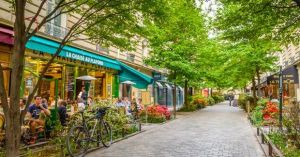
Le Marais is an emerging gay district in Paris, France. Also known for its large Jewish population, Le Marais is packed with remarkable architecture and trendy boutiques, all destined to be discovered in a maze of narrow cobblestone streets. Paris was one of the first capital cities to elect an openly gay mayor. In-office from 2001 to 2014, Bertrand Delanoe defended an increase in the quality of life for all Parisians while criticizing Pope Benedict XVI’s comments on the ineffectiveness of condoms to reduce the spread of AIDS.
5.Oxford Street
Sydney

While Le Marais continues to grow as a gay district, Oxford Street in Sydney, Australia is becoming more “straight”, much to the chagrin of the gay community that once frequented it almost exclusively. Now, straight bars outperform gay bars. Some clubs even sponsor popular wet t-shirt contests. Gay bars are seen by many straight people as a good change of scenery. Although this increase in visitors has brought more business, it has also generated negative headlines. Today, Oxford Street has seen an increase in crime, specifical aggression towards the gay community. However, not everything is terrible on the street that runs through Darlinghurst. Every year, in early March, the streets are closed to traffic so that hundreds of thousands of people from all over the world can celebrate the world-famous Sydney Gay and Lesbian Mardi Gras, one of Australia’s largest tourist draws.
4.Ni-home
Tokyo

Ni-home has the highest concentration of gay bars in the world, with approximately 150 bars and nightclubs densely housed together. In a country where a person’s private life is highly prized, most nightclubs are small and do not house more than a dozen people. Marriage is valued in Japanese culture, leading many locked up men to marry women and then visit Ni-home when the nightlife comes alive. Ni-home’s gay subculture began to emerge after the Prostitution Prevention Act of 1956 outlawed prostitution. Many of Ni-home’s bars cater to specialized interests, including the bear community, BDSM, or younger men. Interestingly, dancing is prohibited in some of these nightclubs. One of the biggest and most popular clubs is “Arty Farty,” which brings a chuckle from those of us who are still immature at heart.
3.Amberes Street
Zona Rosa, Mexico City

Since the 1990s, Zona Rosa, particularly Calle Amberes, has become the most popular gay neighborhood in Mexico City. One of the three areas in the city where gay bars operate, Zona Rosa is the largest with more than 200 businesses spread over 16 blocks. [8] Walking down the sidewalks, one will encounter many gay couples openly holding hands and being affectionate in public. However, Zona Rosa and its gay community still face controversy. Some government officials and advocacy groups claim that minors are often prostituted on Antwerp Street. Locals refute these claims. They say that those who are anti-gay are exaggerating the problem for the gay community to move elsewhere. Although the truth is probably somewhere in the middle, many young men and women flock to the Zona Rosa to escape the pressures of the macho culture around them. Mexico.
2.Barrio de Chueca
Madrid

The Chueca neighborhood is located in the center of Madrid. It is a leading-edge community that prides itself on its tolerance and open-mindedness. Here, intellectuals and artists gather during the day for a cup of coffee and conversation, and at night for dancing and drinking. Famous for its annual Gay Pride parade in late June, Chueca is celebrated for having successfully hosted Europride in 2007, a popular event that welcomed over 2.5 million visitors. Based on this experience, WorldPride named Madrid as the host of its celebration in 2017, where sporting and artistic events celebrated gay culture.
1.Frame de Amoedo
Rio de Janeiro

A famous street in the Ipanema district of Rio de Janeiro, Farme de Amoedo street is the place to be in Brazil. In fact, the gay beaches of Ipanema have been chosen as the best gay beaches in the world. The area is lovingly nicknamed “Barbie Land” for the muscular men who populate the sidewalks. Rio Carnival is celebrated throughout the city. The most popular carnival event for gay audiences is the Banda de Ipanema street parade. First held in 1965, Banda de Ipanema was declared part of Rio’s cultural heritage in 2004. Along with a marching band that plays local music, another highlight of the parade is the many drag queens in elaborate costumes that go up and down the parade route.