Space is full of mysteries, a place that literally has no end. If we assume that it is 93 billion light-years in size, it expands daily with the speed of light. So it is almost impossible to measure the universe. Below we take a look at some of the upcoming space events in 2021 that you can see with the naked eye. Some events are common to all years, but some events are unique.
Important: – All the information given below is collected from different sources so the information may not be 100 percent accurate.
10. ETA Aquariids Meteor Shower
The meteor shower appears every year from April 19 to May 28. But in 2021, its peak will be May 4-6. The origin of the meteor shower is Halley’s Comet which completes it’s only revolves around the sun in 76 years and the next time it will appear in 2061 from Earth. The meteor shower will appear in the direction of the constellation Aquarius. The meteor shower is named after the brightest star in the constellation Aquarius, Eta Aquarii. For people in the northern hemisphere, the constellation appears in the southern sky, and for people south of the equator in the northern sky. You can see up to 50 meters per hour you just need a clear sky.
9. Super Moon
This super moon is unique because it will be a pink super moon. Yes, and the moon will appear on two dates, April 26, 2021, and June 24, 2021. The only thing is, the pink moon is usually 7 percent larger and about 15 percent brighter than the moon. normal. The pink moon is not actually pink. We see it pink because of our atmosphere because the moon is closer to Earth at about 356,907 km and appears to be bigger and brighter. The pink moon is known by many different names, such as The Egg Moon, Sprouting Grass Moon, The Fish Moon, and The Paschal Moon.
8. Total Lunar Eclipse
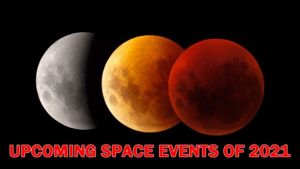
One of the most anticipated lunar eclipses is here on May 26, 2021, because according to NASA it is a total lunar eclipse and it is very rare and usually appears in 2.5 years. The total lunar eclipse is also known as blood moons because of its reddish-orange glow. The good news is that the lunar eclipse can be seen from all over the world from South America, North America, South Asia, East Asia, the Pacific Ocean, the Atlantic Ocean and the Indian Ocean, and even from Antarctica.
7. Solar Eclipse (Ring of Fire)
The solar eclipse usually appears twice a year, but this solar eclipse is rare and appears every 19 years. This year, the solar eclipse will appear on June 21, 2021. In this event, the moon comes between the earth and the sun and covers our sun completely and we see a ring of fire around it. The event is just amazing. The Total Solar Eclipse will be partial and people living in North America will be able to see it easily and fully, but the rest of the world will see it partially in its initial stage. It is not safe to see with the naked eye, so see only with welding goggles n. 13 and n. 14 for safety reasons without affecting your eyes.
6. Mars and Mercury in Conjunction
A conjunction occurs when two planets or celestial bodies approach each other and we can literally see them in a line through the telescope from the ground. You can see the Conjunction on August 18, 2021, because the planets will be closer to each other. But you can see the Conjunction with a telescope and not with the naked eye.
5. Saturn and Jupiter in Conjunction
On August 22, 2021, Saturn and Jupiter will be closer to each other. Since the planets are the two largest planets in our solar system, you can see them through a good telescope. One unique thing is that you can see most of the moons of both planets that you can’t see on normal days. But it will not be visible from all parts of the world.
4. Draconid Meteor Shower
On October 8, 2021, you will see the incredible Draconid meteor shower with 10-15 meteors every hour. Almost 1000 meteors were recorded per hour in 2012 and it is the highest peak Draconid meteor shower ever recorded. It is assumed that the origin of the meteor shower comes from the comet Gaccobini Zinner. It takes about 6.6 years for the Meteor to complete one revolution around the Sun.
3. Jupiter, Saturn, and Venus in Conjunction
On November 25, 2021, you can see the ‘Trie of planets’ or the conjunction of Jupiter, Saturn, and Venus. This phenomenon is not common because scientists say that it appears in many years. On this day you can see two big gas giants and the hottest planet in our solar system is approaching each other. You can also discover the moons of Jupiter and Saturn that you cannot see on normal days.
2. Total Solar Eclipse
On December 4, 2021, the second total lunar eclipse of the year and the penultimate space event of the year will take place. It won’t be the same as the Ring of Fire, but it will be a partial solar eclipse all over the world except Antarctica. Yes, you can see the total solar eclipse from Antarctica in the month of December.
1. Geminid Meteor Shower 13 December
On December 13, 2021 we will see the last space event of the year. It is an annual meteor shower and appears in the direction of the constellation Gemini. This meteor shower is unique in that it is formed by an asteroid, not a comet. Its origin is from the asteroid 3200 Phaethon. You can see up to 120 meteors every hour.